Showing posts with label Audience insights. Show all posts

Thursday, 4 December 2014

Mobile Ecosystem Continues to Mature


New research from Gartner and Nielsen indicate that despite smartphone users having an average of 42 apps on their devices, 55% of users only use between one and four apps. Smartphone users usually download apps in the first place for leisure or entertainment (53%) or a recommendation from a friend (48%). The corresponding figures for tablet owners are 59% and 44%. The findings underscore the power of word-of-mouth when it comes to app discovery, which is notoriously difficult because of the more than 1 million titles in both the App Store and Google Play.

Finally, free applications are quickly becoming the norm and by 2017, 95% of apps are predicted to be free with many following the freemium model.

Implications: Despite only being in existence since 2008, mobile applications have become a fundamental part of users daily lives. For example, in the last year only, time spent within mobile apps has grown by 30% to 43 hours time spent per month. The data above indicates how critical it is for brands and advertisers to associate with the core apps used by their target audiences, and to also understand that simply creating an app is not enough - the app will need to serve a valuable role within a consumers life for it to be successful.

Wednesday, 3 December 2014

FedEx Promotes Its SME Customers in Global "Show The World" Campaign


FedEx’s latest global campaign aims to push its status as not just a delivery company for large companies but one that works for SMEs as well.  ‘Show the World’ documents the round the world journey of one man’s bottle of hot pepper sauce - Llewellyn Clarke from the island of Nevis in the Caribbean who, thanks to FedEx, achieves his dream of having his hot pepper sauce enjoyed throughout the world.
The two-minute online film follows the journey of Clarke’s sauce through FedEx’s network from his home in Nevis to a mountain village in China and beyond.
The online-driven campaign also has a social component. People around the world who have tried Clark’s hot sauce submit videos of their first time trying it. Some of these reactions have been incorporated into the main commercial. 

For the region, FedEx also plans the rollout of several video ads showcasing local SME customers. The first, featuring a car decal company in Taiwan, Maxplus, has already been launched. Tentatively, FedEx plans to premier two more spots starring an online clothing retailer from South Korea, Doublju, and promotional gift company from China, Pangea Direct. 

The campaign will run for six months and includes press, posters, digital display and social media activity.
via campaignasia

Monday, 3 November 2014

Asian Millennials' Media Trends

With Asian Millennials having the highest mobile penetration in the world, and being much more likely to spend their time "connected" we have come up with 6 media trends pertinent to Asia Millennials:

1. Dime a dozen digital experiences - Millennials take immersive, crafted digital experiences for granted. They are familiar with and expect the highest standards of engagement and aesthetoc.

2. Social media comes full circle - As fast as we moved from texting to tweeting, we're returning to using mobile messenger apps for those one to one interactions.

3. Choice is changing media consumption - One of our on-going trends, this isn't just about the power and resilience of the TV industry, but rather about how good we have it today when it comes to TV (in all its forms).

4. M-commerce overtakes e-commerce - The exponential decrease in price of both data and technology is driving assimilation of mobile and e-commerce into the daily lives of millennials in Asia

5. Connected devices and connected living - As both digital and physical infrastructure are built upon the Internet, we're seeing a shift from basic wearable devices to increased fragmentation of mobility and increased connected living.

6. Outbreak of screen stacking - The need to work harder to engage consumers with increasingly short attention spans.


Monday, 29 September 2014

Cellcom Uses the Speed Reading Banner to Launch 4.5G

For the launch of Cellcom’s new 4.5G network in Israel, Cellcom wanted today's youth to experience a new way to consume content online. The idea was simple, the 4.5G network is 3 times faster than 3G, so they let the users experience what it’s like to use the internet 3 times faster.
Introducing The Speed Reading Banner; a contextual smart banner that was featured in every article in the country’s leading news site, specifically designed to let users read them at Cellcom’s new 4.5G network speed.
Normally, a person reads around 180 words per minute and 80% of reading is wasted on eye movement from left to right. The technique behind The Speed Reading Banner is called RSVP (Rapid Serial Visual Presentation) which shows the user only 1 word at a time, enabling him to read up to 400 words per minute.

Trend: Localizasian

When it comes to innovation – and delighting consumers – the idea that ‘western’ brands are still the yardstick against which Asian brands should be measured just doesn’t stand up anymore.

Today, Asian consumerism sets its own standards. And that means Asian consumers are now flocking in rising numbers to Asian brands that are catering to their lifestyles and their wants and needs – and doing it with the kind of expertise that only a local brand can bring.

From Trendwatching comes the latest trend - LOCALIZASIAN: where Asian consumers are embracing new products and services targeted at their needs and wants by Asian brands that understand them better than competitors outside the region.

The three underlying forces for Localizasian:
1. Rising affluence - Explosive growth in the Asian middle classes means millions more Asian consumers with high expectations.
2. Local Love - Asian consumers are increasingly determined to invest in, reimagine and showcase their own  localities, traditions and cultures.
3. Home Advantage - No one understands Asian consumers quite like Asian brands.

Thursday, 26 June 2014

4 Key Trends From E3 And Why They Matter

Every year, the video game industry gathers for the Electronic Entertainment Expo (E3), an annual trade show hosted by the Entertainment Software Association (ESA) at the Los Angeles Convention Center. 2014 marked E3’s 20th anniversary, and the most exciting event yet.

Here's the 4 key takeaways!
•The rise of virtual reality will eventually present brands with the opportunity to test and demo new brands and products from the comfort of people’s homes.
•The DIY development trend should result in innovative ways for marketers to explore brand showcase opportunities within the gaming space, perhaps by tapping into the notion of open source marketing.
•Leveraging and aligning with gamers’ notion of nostalgia, including brands, games and characters, can help marketers cultivate deeper relationships with gamers in new and meaningful ways.
•Real-life gaming experiences for sports brands allows for deeper brand integrations that provide genuine value and enhance gameplay for users.

Read the attached for more.

Wednesday, 28 May 2014

The Return of A Share: Quantifying the Monetary Value of Social Sharing

We know that online reviews matter because people use them to make decisions. But how exactly does all of this chatter affect the bottom line for the business being praised or picked apart? 
A new study by social analytics firm ShareThis quantified exactly how much more people were willing to pay for products—iPads, cars, various ingredients for recipes, etc.—based on reviews they encountered in-person and online. 

For the first time ever, ShareThis has quantified the dollar impact of an online share. In particular, they looked at the consumer goods, tech and auto vertical.

Wednesday, 16 April 2014

MEC and CNBC release The Connected CEO 2.0 study

For a second consecutive year, MEC, and CNBC, have partnered to conduct a highly in-depth research study, The Connected CEO 2.0, to find out the digital behaviors of top Asia business executives. The new research study, which was conducted between July and October 2013, included one-on-one interviews with top executives of multi-national companies across Singapore, Hong Kong and India. 

Key findings of the study showed that: 
  • C-suite fragment their use of multiple digital devices based on device limitations.
  • Content curation and aggregation feature on top of the wish list.
  • C-suite adoption of social networking in a personal capacity still low.
  • C-suite respond to brand communications, but want to consume ads on their own terms.
Fragmented use of digital devices, behavior influenced by device limitations 
Attitudinally, C-suite are screen agnostic. They are receptive to accessing content from all kinds of digital devices and do not differentiate between screens, be it a tablet, smartphone or laptop. 

➢ Some media titles are still perceived to be better optimized for one device but not others. 
➢ Tablets continue to make inroads, blurring the line between work and play. 

“Some brands are not set up properly. Whenever I try to access a particular title on my phone, it hangs and crashes,” said a CEO from Singapore. The need is not for replicating, but maximizing and tailoring content to each device’s strength, making content display seamlessly across various devices.
 
Compared to our observation from the earlier study where the tablet was just starting to evolve into a work device, it has now replaced traditional laptops for work meetings and travel; at home the same tablet is also used for entertainment. Dissimilar to a phone or laptop which is guarded for own usage, CEOs have no qualms sharing the tablet with their kids. “Our research shows that C-suites have wholeheartedly adopted tablets across all markets. Interestingly, as a device, tablets span the personal (used for entertainment, and shared with the family) as well as the professional in a way PC’s do not. Adopting communications tailored to the tablet, thinking about portable content and interactivity will be crucial for brands looking for distinctive ways to target the valuable C-suite audience”, commented Charlotte Wright, Head of Planning, MEC Asia Pacific. 

Case Study: This Is the World's Toughest Job, and Billions Are Already Doing It

Via Mashable

Twenty-four applicants who applied for the world's toughest job could not believe their ears: 24/7 work, no rest, no breaks, no vacation — and it pays absolutely nothing. 

"365 days a year? No...that's inhumane," said one applicant.

There are some upsides to it, though. "The meaningful connections that you make and the feeling that you get from helping your associate are immeasurable." Still, the applicants weren't convinced — until they heard what the "job" actually is.
Actually a clever campaign for Cardstore.com, created by Boston-based ad agency Mullen, the video has a surprise ending — check it out above and tell us what you think in the comments.

Thursday, 27 March 2014

Millennials' Social Media Posts Influence Peers to Buy New Products

Via eMarketer

Nearly seven in 10 millennial social users are at least somewhat influenced to purchase based on friends' posts.

Millennials are significantly more likely than older generations to be influenced by their friends’ social media posts about products and services. According to January 2014 polling conducted by Harris Interactive for The Webby Awards, 68% of 18-to-34-year-old social media users surveyed were at least somewhat likely to make a purchase after seeing a friend’s post.
Dissimilarly, 78% of social media users 65 and older said they were not at all likely to make a purchase based on what they saw on their friends’ feeds.
The study found that the majority of posts on social networks about new products and services came from women, especially those 44 and younger. Just 18% of females between the ages of 18 and 34 said they never posted about new products and services. More than half of women between 35 and 44 posted about new products and services at least sometimes.

Saturday, 22 February 2014

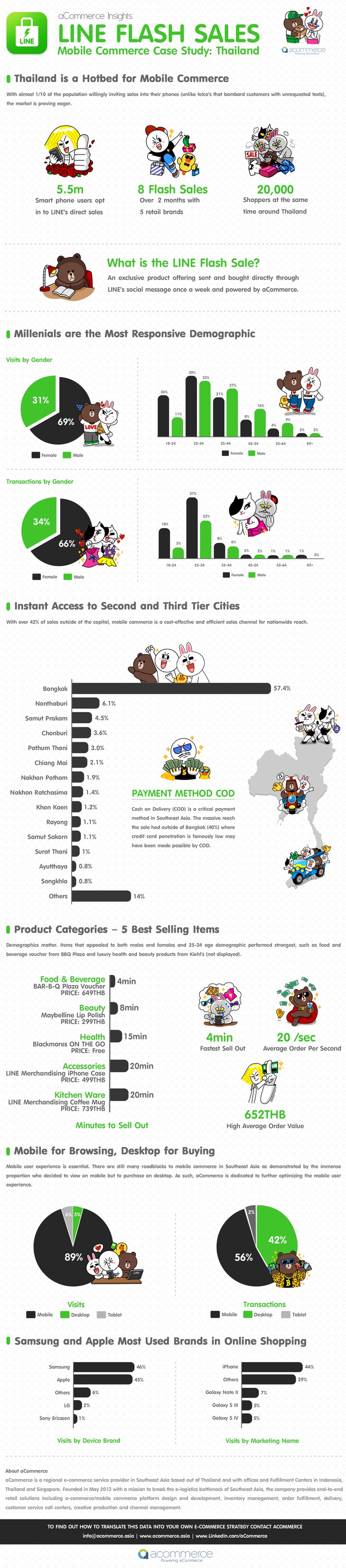
Line pulled in 5.5 million interested shoppers for its flash sales in Thailand

Via Techinasia
2013 was a year of social e-commerce in Thailand, with growth in online sales on Facebook, Instagram, and via smartphones.

In Thailand, the messaging app Line has shown the way in mobile commerce. It has run a series of Line Flash Sale events online, including the sale of Maybelline lipstick, Line’s own branded merchandises, and even a food chain store’s discount coupons. They’re interesting examples of social-driven m-commerce.

Since Line is a mobile chat app and not an e-commerce platform, it needs partners in order to run sales campaigns. aCommerce is Line’s partner for all the logistics of its Line flash sales in Thailand [1], and aCommerce has put some of its data into the infographic below.

Monday, 17 February 2014

Singapore: Facebook Trumps Google in Consumption Figures

In a recent report, Facebook has emerged tops over Google (including Youtube) in both time spent as well as pages viewed per month. With 322 average page views per month, Facebook is in the lead over Google (212), eBay (43), Microsoft (67) and Yahoo (105).
Also, with 3 million active users online, Singaporean users dispense 312 million likes each month reflecting a high affinity for each user to 'like' posts shared online.
For more details about Singapore's Facebook consumption as well as other APAC markets, read the full report.

Thursday, 23 January 2014

iOS users most engaged on FB, Twitter

Via Digital Market Asia

As mobile users proliferate, there is a clear correlation between mobile ownership and active usage – indicating the importance of mobiles as a facilitator for social networking across all of the largest social platforms.
As per a study for GlobalWebIndex, it can be seen that the usage patterns vary depending on which mobile operating system is being used. Compared to the overall internet audience, iOS users lead for Facebook – with 58 per cent being active members. The same pattern is evident for Twitter, where the iOS group is nearly 10 per cent ahead of the average. For Google+, meanwhile, it’s Android users who are the most engaged.
Chart1

Wednesday, 11 September 2013

Apps Drive Smartphone Engagement, Browsing Wins on Tablets

Source: comscoredatamine.com

Digital consumers rely on both apps and mobile browsing when engaging with retailers online, but this engagement varies greatly depending on device. While apps drive the vast majority (78% of time spent) of retail category engagement on smartphones, mobile web browsing is actually the preferred engagement method for tablet users in the category (56% of time spent). Retailers that understand how consumers are engaging with their brands on smartphones and tablets can better shape their business strategies to drive sales and grow their customer base.

Thursday, 5 September 2013

Lessons In Mobile Marketing

Source: marketing-interactive.com

A recent report by Deloitte indicated that 80% of branded apps have been downloaded less than a thousand times, with only 1% actually exceeding one million downloads[1]. Branded apps are largely failing to attract attention.
This reflects the state of mobile marketing as a whole: ripe with opportunity but an ever-growing graveyard of failure. 
We have found that the few brands that have managed to achieve app success share one simple characteristic: customer-centricity. The apps add tangible value to peoples' lives in seamless and consistent ways.
Adopting this approach requires two critical shifts as to how brands must and should view mobile engagement with customers: (1) brands must change focus from generating transactions to fostering relationships, and (2) brands must evolve from selling a lifestyle to serving a memorable experience.

Monday, 26 August 2013

How to Make Your App More Engaging

Source: mashable.com
App
What's the best way to grow engagement in mobile apps?
First things first: Do you want to make an app that people like? Then maybe you shouldn't conflate "engaging" with time spent.
It turns out some of the most beloved apps are those that users can zip in and out of rapidly.
That was the finding of a 2011 study that looked at rates of engagement for branded apps. The upshot: Apps are a great vehicle for engendering good feelings about your brand. But informational, ostensibly less engaging apps were more likely to engage users than games or entertainment.

How the Smartphone Market Has Changed Since the iPhone 5

Source: mashable.com
Iphone-5
If recent reports are accurate, Apple will unveil the next-generation iPhone — or iPhones — in just under three weeks.
Every new product from Apple is big news, especially when the company goes nearly a year without a major product launch. But nothing compares to the iPhone. Apple is, at least for now, still primarily a smartphone company: It generated $18.1 billion in revenue from iPhone sales in the most recent quarter, more than all of its other product categories combined.
However, when CEO Tim Cook takes the stage next month to kick off the iPhone event, he will be pitching a product for a smartphone market that has changed in several noticeable ways since he and Apple introduced the iPhone 5 a year ago. The iPhone's success will depend in large part on how Apple has adapted to these changes.

What's The Best Way To Communicate With Your Users?

Source: mashable.com
Mailbox-messaging
What are the best messaging platforms to communicate with users?
Like many questions, this one can be answered rather easily, with: "It depends." Every startup's product is different, every message is different and there are a lot of ways to send messages to users. The number of channels you can use to communicate with users continues to rise. Social platforms built for connecting with friends turned out to be effective at spreading messages about products and services.
Even email, while it is a single platform, has many nuances in terms of how email campaigns can be targeted based on user habits or actions inside your product, if it's an application that can trigger reminders or affirmations. Let's take a deeper dive into the many options so you can learn which messaging platform is best for your needs.

Nielsen: Twitter And TV Programs Are Becoming Fast Friends

Source: mashable.com
Twitter-eggs
Nielsen released findings on Tuesday that shine the spotlight on the two-way relationship that has been burgeoning between TV viewership and Twitter as of late.
The information and global measurement company's independent Twitter Causation Study tapped time series analysis to see if Twitter conversations drove increased tune-in rates for broadcast TV, and to note if broadcast tune-in led to increased tweeting. The study revealed that live TV ratings had a statistically significant impact in related tweets among 48% of the episodes sampled and that the volume of tweets caused statistically significant changes in live TV ratings for 29% of episodes.

Google: 1 in 2 Tablets Activated Runs Android

Source: mashable.com
Android-tablet
Every other tablet that's activated is an Android tablet, Google has revealed. In addition, the momentum for Android tablet sales has accelerated considerably in the last year, the company said, with more than 85% of Android tablets activated in the last year.
Google's head of Android and Chrome, Sundar Pichai, announced the statistics at an event in San Francisco on Wednesday. At the end of 2012, he said, Android tablet activations were approaching 10 million. Today, Pichai said they stand at 70 million.
How many of those tablets are Google-branded tablets? Pichai had some numbers to share about that, too, announcing that 10% of all Android tablet activations are Nexus 7 tablets, a device that debuted about a year ago at Google I/O 2012. He didn't say how many customers have bought its larger brother, the ultra-high-resolution Nexus 10, introduced in October last year.
Pichai also announced that the official Android app store, Google Play, now holds 1 million apps. The next generation of the Nexus 7 also made its debut.